“Not a Good Place for Research”: An Ethnographic Tour Along Bulgaria’s Southern Border
by Danielle Jacques

On a sunny Saturday in late autumn, I found myself bouncing along a winding path in the back of a lifted Jeep with no seat belts, just outside the southern Bulgarian village of Mogilitsa. I’d come to this area for the annual bean festival in Smilyan, but because of the recent spike in COVID-19 cases in Bulgaria (where vaccine hesitancy is an ongoing problem), most of the festivities had been cancelled at the last minute. Rada and Hristo, a couple from Sofia, and their young son Ivo were the only other folks staying at my hotel and they had invited me to join them for a trek up to a viewpoint at the top of one of the mountains nearby. Determined to salvage the day, I’d graciously accepted. We all packed into the Jeep, which took our driver Boris about seven tries to start before the engine would finally turn over, and we set off up a steep rocky road that was far more rock than road. For most of the drive, I death-gripped the seat in front of me with both arms and legs to keep myself from landing on top of Ivo, who was sound asleep next to me.
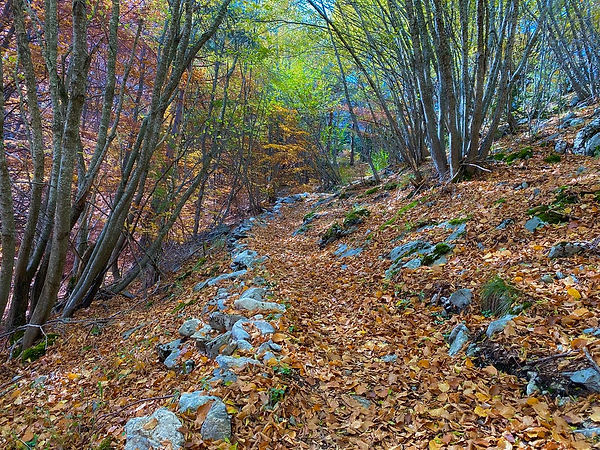
Disoriented by all the bumps and turns and steep drop-offs each time I looked out my window, I asked what this path was used for. At first, I assumed it was part of a logging route, but the road was too narrow and jagged to accommodate that kind of heavy machinery. Boris explained—as Rada translated—that this particular path connected Mogilitsa to a small settlement of about fifteen houses just over the next hill. Of those fifteen houses, only one was occupied. All the other families had left. As we would see, though, this was just one in a network of paths criss-crossing over hills, through forests and pastures, accessible only by truck or tractor. These roads, the driver told us, were once used by the shepherds who grazed their sheep here. Of course, I thought: these trails were meant to be walked, not driven.
A rocky path through the woods near Mogilitsa.
We soon reached a clearing where the rocky road turned into a dirt path that cut through a pasture sloping gently to one side. “His grandfather was a shepherd,” said Rada, nodding towards Boris. “His whole family had sheep, just like everyone who used to live here.” I nodded knowingly, surprised by the strange sense of familiarity I felt driving through the empty pasture.
I came to Bulgaria on a Fulbright grant to research food and representations of national identity in the tourism industry for my Master’s thesis in Gastronomy. Not only is Bulgaria an ethnically diverse country, but its mountainous terrain and variable weather patterns have resulted in food traditions that remain incredibly region-specific. Smilyan, for example, gets the right amount of rainfall, sunshine, and warm, southern winds for its giant purple beans to thrive, whereas just over the hill in Smolyan, they don’t grow at all. In the 1950s and '60s, though, the country underwent a process of “standardization” whereby the Socialist regime attempted to snuff out regional loyalties in favor of a unified national identity (Shkodrova, 2020). One part of this effort was a mandate that all restaurants throughout the country serve the exact same dishes, under the same names, using the same ingredients. I wanted to understand the implications of this history in the present by asking the fraught question: what is “authentic” Bulgarian cuisine? What’s included and what’s left out? How is food used as a tool to construct and maintain definitions of belonging?
During the first few months of my research, as I collected as many answers to these questions as I could, I felt myself being pulled in an unexpected direction: the dairy industry. This was not entirely by accident. I grew up on a dairy farm in rural Maine and worked in the cheese industry for several years prior to coming here, so my curiosities often led me into cheese shops and prompted me to scrutinize labels on yogurt containers at the market. I even picked my hotel in Smilyan, called “Mlechen Dom,” or dairy inn, because it was run by a woman named Milkana, a highly reputed and aptly named cheesemaker. Up to this point, these two interests had run parallel to one another, never intersecting in any clear and concrete way. As I probed issues of national identity as portrayed, or performed, in the context of tourism, I also asked questions about the peculiarities of Bulgarian dairy for my own enjoyment. But as Boris, who makes a living driving tourists past empty houses and empty pastures where his family’s sheep once grazed along Bulgaria’s southern border, drove us up the mountain, it occurred to me that I’d stumbled upon a connection.
A Note on Methods
I use the term “ethnographic tour” while recognizing it to be something of an oxymoron. Ethnography in anthropology requires extended immersion, or long-term participant observation in a community, with the ultimate goal of understanding and interpreting the world from an “insider” perspective. Tourism ethnography, then, presents a host of methodological problems. In the tourism industry, guides do the work of interpreting the “inside” world for the “outsider,” typically with the ultimate goal of curating some sort of comfortable, even pleasurable passage through the unfamiliar. Do I focus on the tourists themselves by attempting to work my way inside a “community” of individuals from across the globe who happen to be in the same place at the same time? Or do I follow the guides, who generally lead tours a couple times per week as a second or third source of income, and often have limited liberty in the topics they cover? Neither option lends itself to sustained participation or observation, and either case brings up questions regarding imagined boundaries between inside and outside.
Reading up on anthropological methods in preparation for my research, I quickly realized that ethnography, as it was originally conceived, was simply not intended for this purpose. Quite the opposite, actually. Communities subjected to early ethnographic analysis were (inaccurately) depicted as “isolated” rather than inter-connected, and anthropologists erased the tourists who appeared in their field notes from final publications, reinforcing fantasy-narratives of discovery and myths of the lone genius, and justifying projects of colonization. As Bruner puts it, “anthropology as a scientific discipline is dependent upon its being distinguished from tourism” (2005). This is precisely why “ethnographers have gone to great lengths to differentiate their accounts from those provided by missionaries, explorers, colonialists, travel writers, journalists, and, now, tourists… Yet the similarities are disturbing as so many others journey temporarily to distant lands, observe and experience, and return home with stories about their encounters.”
While the motivations of those other international travelers were morally dubious, ethnographers were backed by scientific objectivity and were therefore morally vindicated. Whereas travel writers and journalists wrote for the layperson back home, ethnographers wrote for an exclusive group of “experts.” Contrary to tourism, which was temporary and superficial, ethnography was long-term and serious. Like all forms of categorization, early ethnographers defined themselves against others, minimizing similarities and overstating differences. Of course, the postmodern identity crisis in anthropology attended to some of these discursive distinctions. “We are all tourists,” Bruner quotes Sidney Mintz. Still, I continue to interrogate the borders and boundaries around “ethnographer” and “tourist” in my work by attempting to occupy the gray area between them. In doing so, I embrace the invaluable anthropological insight that stories and experiences are real and vital sources of knowledge while rejecting the gatekeeping that reproduces power differentials through the art and science of exclusion.
What follows, then, is an unselfconscious hybrid of ethnography, travel writing, journalism, even personal diary from one day of touring villages, climbing mountains, and eating in the southern Bulgarian Rhodopes. I do not claim to make any sort of authoritative argument substantiated with irrefutable evidence. Instead, I offer observations and anecdotes, filtered through my own subjectivity, personality, interests, abilities, and limitations. Still, I believe the lessons I learned in these 16 hours may be of value to others. I learned that entering “the field” as myself, as an engaged learner with a particular history that has shaped a particular perspective, is the key to unlocking doors I didn’t know were there. I learned what seasoned researchers likely know very well, that planning is futile and the most fruitful days result from a magical mix of serendipity and the kindness of strangers. Finally, I learned that arbitrary borders and boundaries limit our potential and that questioning them in all forms is a necessary step towards a more expansive and inclusive future.
Penka’s Blankets
The Jeep lurched sideways, nearly tossing me out the window, as Boris gestured towards the right. “See that little tower?” I craned my neck around and up and spotted it on top of a cliff, just before we turned a corner and it left my line of sight. “That used to mark the border with Greece,” he said. A border like any other, I thought, fixed in neither time nor space. When did it move, and why? Who decided, and to what end? We carried on. Before long, we emerged from the woods and circled a pasture nestled just above the tree line. Boris pulled over and pointed out the driver’s side window. “See those trees over there, on that second hill?” Tall evergreens jutted out behind stands of rusty orange and the occasional burst of yellow. “That’s Greece,” he said unceremoniously, and put the Jeep back in gear.
“It’s less than a mile away,” Rada told me. The landscape looked exactly the same in every direction, but Boris was attuned to precisely where the border severed two identical worlds. The story of Bulgaria’s border with Greece, the story of Boris’s family’s sheep, and the story of all these empty houses were, I soon realized, all the same story.
To explain this, I’ll have to back up to the beginning of the day. I entered Milkana’s dining room around 9 a.m., bags packed and prepped for the short walk to the center of town after a quick breakfast. Milkana served a stack of Rhodope-style pancakes made with yogurt, two of her homemade cheeses, quince jam, and tea made from a local herb called mursal, which only grows in this area. As I enjoyed my spongey, chewy pancakes and sticky-sweet jam, Rada and Ivo sat down at the table behind me. We greeted one another, having been introduced the night before.
Rhodope-style breads, homemade cheese, and pickled vegetables from lunch in Gorna Arda.
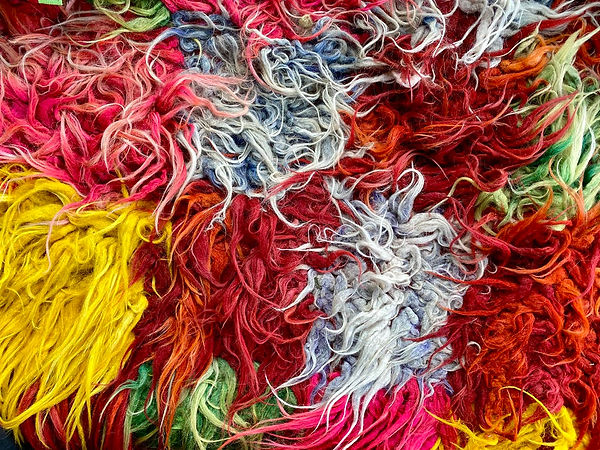
“Do you want to come look at the jams with me?” Rada asked, referring to the vendor selling homemade preserves outside. I joined Rada and listened as she asked questions about the preserves: wild strawberry jam, rosehip jelly, hot and mild pickled peppers. Behind the woman was a stack of stunning blankets: black, yellow, and red stripes, shaggy wool splotched with dyes of all colors. Some orange and green plaid; some delicately hand-stitched red and white tablecloths. The woman caught me eyeing them and asked if I wanted to take a closer look. They were incredible, I told her. “Penka’s grandmother made those, aren’t they beautiful?” Rada chimed in. “They’re made with wool from the local sheep and dyed in traditional Rhodope colors and patterns.” I looked over at Penka, who was probably in her seventies, and considered that these blankets were two generations older than her. “Women used to weave these blankets as part of their dowry for when they got married. They needed to be able to furnish their new houses.” Yet here they sat. I wondered how these ancient blankets met this particular fate, on sale for tourists in a parking lot.
A traditional Rhodope blanket.
I’d read that the Rhodopes were famous for their sheep products. I’d seen signs on the side of the road for ovche mlyako (fresh sheep’s milk) during my drive to Smilyan. There were old-timey pictures of shepherds hung up in Milkana’s mandra, one of them with a caption reading, “The flocks are passing the Bulgarian-Greek border near Shain, 1933.” Rhodope music was famous for its low-toned bagpipes made from sheepskin. I brushed the back of my hand over the coarse wool of Penka’s blankets, one of a series of clues about the significant role shepherding had once played in so many aspects of life here in the Bulgarian Rhodopes. But where were the sheep?
Rada asked if I wanted a ride to the festival, and we drove a few short minutes to the town center where we found just two vendors selling beans. We headed toward the municipality building where there were some tables lined up, covered with mosaics made of different colored beans. There was a sculpture of a squirrel, the famous Smilyan clocktower, a face mask, and lots of drawings of cats, all decorated with beans. We figured out pretty quickly this was all there was to see. Rada and Hristo invited me to join them for the day, and after we each bought a kilogram of Smilyanski beans, we were on our way to Mogilitsa.
When we arrived, we found the Jeep but not the driver. While we waited for him, Rada showed me around the town. We peaked into a store underneath the mosque where more Rhodope blankets were hanging along with mittens, cowbells, and dried herbs. A woman in a headscarf joined us and offered me a chocolate-coated cookie, which I accepted. We continued walking down the main street until we reached a sprawling white building with a decorative tower. I recognized it from pictures I’d seen on tourism pamphlets about the Rhodopes. “This is the Agnushevi konatsi,” Rada told me. The mansion was built by a very wealthy family in the nineteenth century. It’s typical of the “revival period” architecture, one of many houses of its kind built by merchants and businessmen who got rich selling wine or rose oil abroad.
“How did this family make their money?” I asked Rada.
“They were shepherds,” she replied as if it were obvious, and I stopped dead in my tracks. “They had the largest flock in this village. Hundreds of thousands of animals.”
Not a Good Place For Research
Questions poured out of me. How was this possible? Where did the sheep go? The shepherds? Why is this house, like so many others, sitting here empty? Where is the family now? Rada explained what she knew patiently, and I filled in the blanks with the bits and pieces of information I’d picked up here and there during my solo explorations into the world of Bulgarian cheese. Shepherding had been central to Rhodope livelihoods for centuries. The mountains offered diverse vegetation for the sheep to graze in the summer. But during the winter months, the northern section of the mountain range got too cold for the sheep to survive outside, so shepherds used to cross the border into Greece and travel south for the winter toward the Mediterranean where the greenery lasted all year. “There were seventeen passes throughout the Rhodopes that connected Bulgaria to Greece, and the shepherds used to move easily through them,” Rada told me. “Everyone knew that the shepherds had two families. One in Bulgaria and one in Greece,” she laughed.
In the 1940s, though, once the Bulgarian Communist government established itself, this way of life became impossible. The regime closed the border between Bulgaria and Greece, which was not a Communist country, and made both trade and migration with southern neighbors over the border against the law. All seventeen of the passes were closed. Previously, I’d been told that the government slaughtered thousands of heritage breed sheep and replaced them with highly productive hybrid cows in an effort to industrialize the countryside (though, according to my source, any documentation of this was likely destroyed). Regardless, this border fortification marked the end of centuries of shepherding in the region. Families were relocated, forced to move to cities to work in the factories. Those who stayed worked in the mills in the mountains. I thought about Penka’s blankets and wondered what decade her grandmother worked that wool and whether these were the last batch in her family. “It’s really a shame, what happened with the sheep,” Rada concluded.
The Jeep arrived soon, and we began our ascent. On the way to the viewpoint, we stopped to harvest perfectly ripe shipki (rosehips) and popped them in our mouths. We saw makeshift aquaculture pools in the tiny cluster of houses outside Mogilitsa, where the last family in the area was growing river trout in their front yard for their own consumption (Rada insisted on buying some, but Hristo vetoed this idea). Boris played a mix of '80s pop hits and Bulgarian folk classics. At one point, “Dangerous” by Swedish pop duo Roxette came on. “Hold on tight, you know she’s a little bit dangerous.” I laughed to myself, bouncing along, gripping the seat in front of me while staring out the window down a steep ravine full of fallen leaves.
We found more clues, signs of shepherding, but still no sheep. In the middle of a pasture, Rada spotted an overturned pipe propped up on two stumps, and Boris explained that this was designed to catch rainwater for the sheep to drink. Exploring the hillsides later on, I noticed a wooden fence with a gate opening into a pasture. Draped over the fence, there was a sheepskin vest. I reached out and touched the wool. It was dry, and the hide was stiff. It looked like it had weathered more than a few rainstorms here on the fence. I wondered how long it had been there, who it belonged to, why it was left behind.
An abandoned sheepskin vest draped over the entrance to a hilly pasture.
As the day progressed, Rada and Hristo asked me questions about myself and my research. We talked about our travels, especially in Spain, and all our plans that were put on hold during the pandemic. They said they were lucky to live in a place like Bulgaria, where traveling is always interesting and there’s always something new to see. I told them the history of my family’s own dairy farm, the empty pastures that were once full of happy cows, and my dreams of grazing sheep there someday. I told them about my interest in food and tourism, particularly in rural areas. And I asked them about sheep. I wondered out loud if Bulgaria’s entry to the EU had changed anything here. There was, of course, a lot of hope at the time that accession would benefit the poorest populations in Europe’s poorest country.
“In theory, this should have opened the borders with Greece,” Hristo explained. “But all the passes stayed closed, so there’s still no easy way to get across.” Rada explained that the only way into Bulgaria from the Greek Rhodopes was to drive to Drama and get on a train to Sofia or Plovdiv. “Maybe someday that will change, though,” Hristo offered. “Maybe someday the shepherds will be able to load up their sheep in trucks and drive them across the border. But for now, it’s impossible.”
Rada looked at me apologetically. “This is not a very good place for research,” she said.
It was a loaded statement, a sentiment that I’ve heard over and over in my conversations with Bulgarians. I’ve been alternately told that Bulgaria is “in a constant state of potential,” and that I’m too late, that this is a waste of my time, that there’s nothing here for me—as if a beautiful, thriving Bulgaria exists only in the past and in the future, not the present.
When we reached the viewpoint, Rada and Hristo waited their turn to take a picture with Ivo, and I took a few quiet moments to observe the landscape. I tried to imagine what the area might have looked like 80 years ago, when thousands of hungry ruminants grazed these hills. I wondered how much of the land had been reforested since then, without the sheep here to maintain the pastures. What would it take to bring animal agriculture back to this area? Would it ever be feasible again? Did anyone here even want that? What else could possibly fill the void left behind by the shepherding industry… tourism? I’d heard from a handful of Bulgarians that rural tourism was the last bastion of hope for reconstituting the crumbling countryside.
The viewpoint, with Mogilitsa seen below.
And then, I saw them. In a pasture across the way, there was a small herd of sheep. The brightness of their wool reflecting the sun caught my attention. At first, I thought they were rocks, but they moved slowly and steadily in a cluster towards the edge of the pasture. I watched as the sheep disappeared behind some trees, marveling at the set of circumstances that brought me here just in time to see them go.